
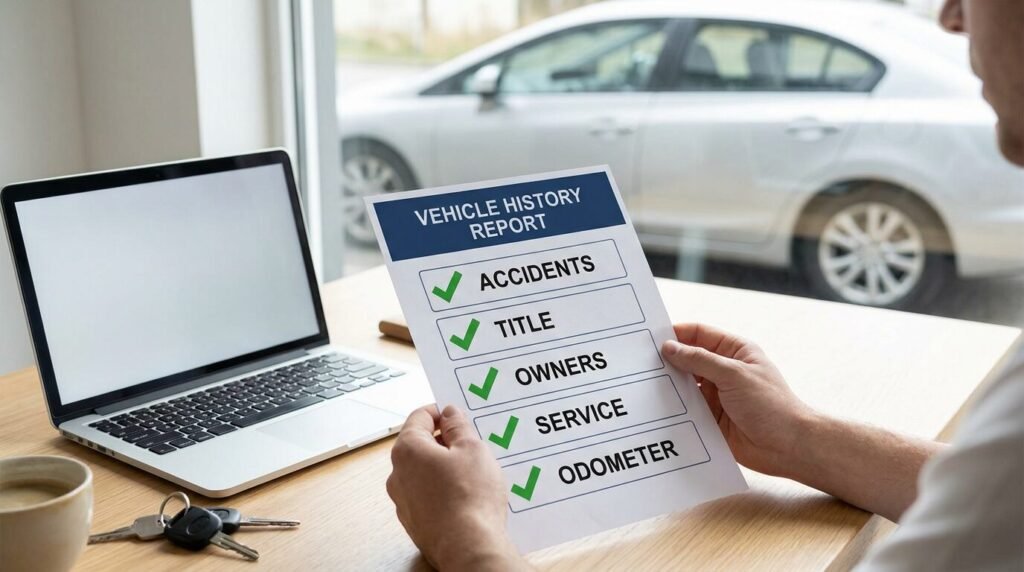
Before you buy a used car, a Carfax report is the quickest way to see what’s happened to it. But what exactly does a Carfax report show — and what doesn’t it show? Here’s a plain-English tour of everything in the report, and how to use it to decide. If you don’t have the report yet, cheap Carfax reports from CarfaxDeals cost $5 each.
What is a Carfax report?
A Carfax report is a vehicle history report: a timeline of the records reported about one specific car, matched by its 17-character VIN. It pulls those records from sources such as state DMVs, police departments, insurance companies, auctions and service shops — here’s how Carfax gets its information. It tells you what has been reported about the car’s past; it doesn’t inspect the car itself.
What does Carfax show? The quick answer
A Carfax report shows a car’s accident and damage history, title history and title brands, number and type of owners, service and maintenance records, odometer readings, open recalls and how the car has been used — personal, rental, lease or fleet. Here’s what each part tells you.
Accident and damage history
Reported accidents and damage, with the date and, when available, how severe it was (minor, moderate or severe), where the car was hit, and notes such as airbag deployment or structural damage. Learn what those labels mean in minor damage on Carfax and functional vs structural damage.
Title history and title brands
The report checks the car’s titles for brands that seriously affect its value and safety — salvage, junk, rebuilt, flood, fire, hail, lemon or manufacturer buyback, and odometer problems. A branded title is one of the biggest red flags you can find. See what is a salvage title?
Ownership history
How many owners the car has had, when it changed hands, the state it was registered in, the type of owner (personal, lease, rental, commercial or fleet) and roughly how long each kept it. It does not show owners’ names — here’s why.
Service and maintenance records
Oil changes, tire rotations, brake work, inspections and repairs reported by dealers and service shops, often with the mileage at each visit. A long, regular service history is a great sign. Gaps don’t always mean neglect — not every shop reports — but they’re worth asking about. You may also see dealer entries such as “vehicle reconditioned”.
Odometer readings
Every mileage reading reported over the years, from services, inspections and title transfers. The report checks that the numbers only go up and flags a potential rollback if they don’t — see what is odometer rollback?
Open recalls
Manufacturer safety recalls that haven’t been fixed yet. Recall repairs are free at franchised dealers, so an open recall isn’t a deal-breaker — just get it done. You can also run a free check with our recall checker.
Other events you may see
- Total loss — an insurer declared the car a total loss.
- Loan or lien reported — a lender had a claim on the car at some point.
- Registration and inspection events — renewals and state inspections, often with mileage.
- Listings and sales — when the car was offered for sale or sold at a dealer or auction.
What a Carfax report doesn’t show
- Owner names or personal details — protected by federal privacy law.
- Accidents and repairs that were never reported — for example, damage fixed privately for cash.
- The car’s current condition — worn brakes, leaks or a failing transmission won’t appear unless a shop reported them.
That’s why “clean” isn’t the same as “perfect” — see is Carfax reliable?
How to read a Carfax report in five minutes
- Check the title section first — any brand is a major red flag.
- Read every accident or damage record, including severity and location.
- Count the owners and note any rental or fleet use.
- Scan the odometer readings for gaps or drops.
- Look for regular service, and any open recalls.
For a section-by-section walkthrough, read how to read a Carfax report.
The bottom line
A Carfax report shows a used car’s reported accidents, title brands, owners, service history, mileage and recalls — the fastest way to rule out a bad car before you spend money on an inspection. It won’t show everything, so use it as your first check, not your only one.