
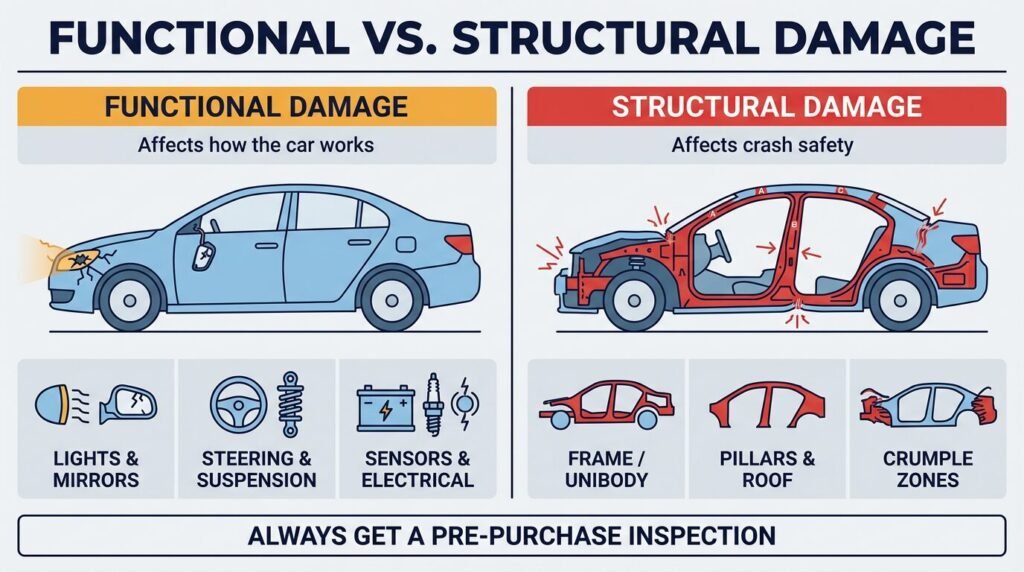
Damage entries are the part of a Carfax report most buyers worry about — and two phrases cause the most confusion: functional damage and structural damage. They sound similar, but they describe very different problems. Here’s what each one means, how serious it is, and how to decide whether the car is still worth buying.
Functional vs structural damage: the quick answer
- Functional damage affects how the car works — parts like lights, mirrors, doors, steering, suspension, cooling or electrical components that stopped working properly after the incident.
- Structural damage affects the car’s skeleton — the frame or unibody, pillars, rails and floor that hold the car together and protect you in a crash.
- Cosmetic damage, for comparison, only affects how the car looks — scratches, scuffs and small dents.
In short: functional damage is usually fixed by repairing or replacing parts; structural damage goes to the core of the car’s safety and deserves much more caution.
What does “functional damage” mean on Carfax?
When a damage record on a Carfax report notes functional damage, it means the incident damaged something the car needs to operate normally — not just its appearance. Typical examples include:
- Broken headlights, taillights or turn signals
- A damaged side mirror, door or trunk lid that no longer works properly
- Damage to a wheel, tire, steering or suspension component
- A damaged radiator or cooling part after a front-end hit
- Sensors, cameras or wiring damaged in the impact
Functional damage can range from minor (a broken mirror) to significant (a bent suspension arm). The key question is whether it was repaired properly with the right parts — especially anything related to steering, suspension, brakes or safety systems.
What does “structural damage” mean on Carfax?
A structural damage note means the incident affected the vehicle’s underlying structure. On most modern cars that’s the unibody — the welded shell that acts as the frame — including:
- Frame rails and crossmembers
- A, B and C pillars (the posts that hold up the roof)
- The floor pan and rocker panels
- The radiator core support and crumple zones
- The roof structure
These parts are engineered to absorb and redirect crash energy. If they’ve been bent and repaired, the car may not protect you the same way in a future collision, and it can develop problems with alignment, uneven tire wear, rattles, leaks, and doors or panels that don’t line up. Structural damage also has the biggest effect on resale value.
Structural damage can be repaired correctly — body shops use frame-straightening equipment and the manufacturer’s repair procedures — but the quality of that repair makes all the difference, and it’s hard to judge without an expert.
How to read the damage details on the report
A damage record gives you more than a label. Look at every detail together:
- Severity — Carfax rates reported damage as minor, moderate or severe. Structural damage usually comes with moderate or severe incidents.
- Location — the graphic shows where the car was hit (front, rear or side). A front-end hit can involve the radiator support and crumple zone.
- Extra notes — entries such as airbags deployed or vehicle towed point to a harder impact.
- Repair records — later entries from a body shop or dealer can show that the damage was repaired.
Don’t have the report yet? A discounted Carfax report costs $5 and shows every damage record for the VIN. For a walkthrough of every section, see how to read a Carfax report. If the report only says minor damage, start with our guide to minor damage on Carfax.
Should you buy a car with functional or structural damage?
Functional damage
Often, yes — if it was repaired properly and the price reflects the history. Confirm that everything works (lights, mirrors, doors, sensors), check the alignment and tire wear, and ask for the repair invoice. A pre-purchase inspection should specifically check the area that was hit.
Structural damage
Be much more careful. Before you buy:
- Get a structural inspection at a body shop that does frame work, not just a general mechanical check.
- Ask for the repair documentation — who did it, what was replaced, and whether the airbags and safety systems were restored.
- Check the title — heavy structural damage is a common reason cars are declared a total loss. See rebuilt title vs salvage title.
- Price it accordingly — a car with structural damage history will be worth less when you sell it, too.
If the repair can’t be verified, or the seller won’t share details, walking away is usually the smart move.
Red flags to look for in person
- Uneven gaps between body panels, or doors and a hood that don’t close cleanly
- Paint overspray on rubber seals, trim or under the hood
- New welds, or crimped or bent metal on the frame rails or trunk floor
- The car pulls to one side, or the tires are wearing unevenly
- An airbag warning light, or airbag covers that don’t match
Our used car inspection checklist covers the rest.
The bottom line
Functional damage means something stopped working properly after an incident; structural damage means the car’s frame or unibody was affected. Functional damage is often fine once it’s properly repaired. Structural damage deserves a specialist inspection, full repair records and a price that reflects the history — or a polite no.