
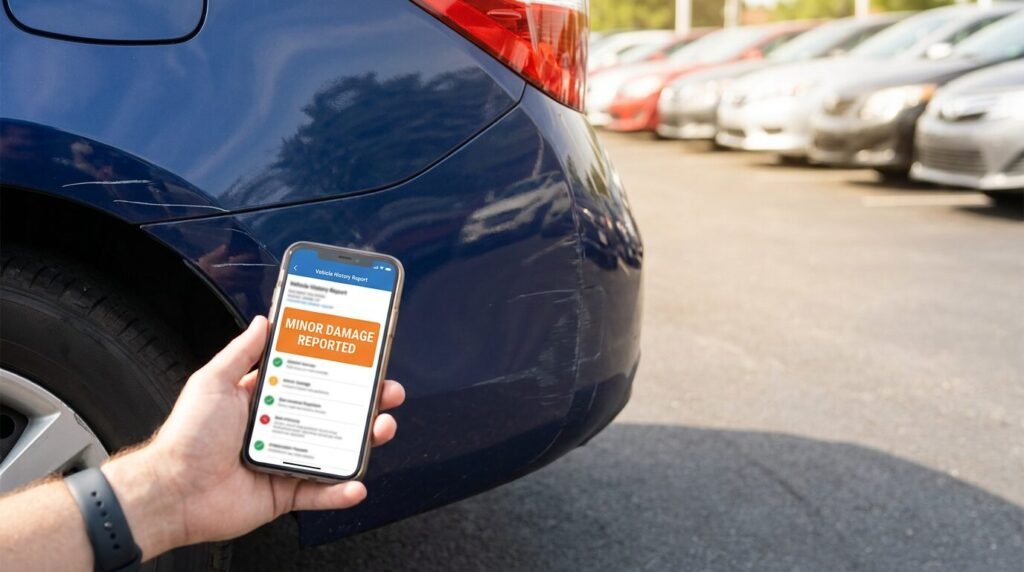
You’ve found a car you like, you pull the Carfax report, and there it is: a damage record marked minor damage. Should that stop you? Usually not — minor damage is one of the most common entries on used car reports. But “minor” covers a range of situations, and it does affect what the car is worth. Here’s how to read it and decide.
What does “minor damage” mean on Carfax?
Quick answer: minor damage is the lowest level on Carfax’s damage severity scale. It usually means cosmetic or limited damage — the kind that doesn’t affect the car’s structure or its ability to be driven safely. Typical examples:
- A scuffed or cracked bumper cover
- Small dents, dings and scratches
- Damage to trim, a mirror cover or a light lens
- Paint damage on one or two panels
- A low-speed or parking-lot collision
The record usually shows the date, where on the car the damage was (front, rear or side), and sometimes where the information came from, such as a police report, insurance claim or repair shop.
Minor vs moderate vs severe damage
Carfax rates reported damage on a three-level scale:
- Minor — cosmetic or limited damage that doesn’t affect how the car drives or protects you.
- Moderate — damage that may affect several parts and can impair how the car works, such as suspension pieces, sensors or cooling components.
- Severe — damage that compromises the car’s operation or safety, often involving structural repairs, airbags or several impact areas.
If the record also mentions functional or structural damage, read our guide to functional vs structural damage on Carfax — those notes change the picture much more than the word “minor.”
Is minor damage on Carfax bad?
Not necessarily. Plenty of well-kept cars have a minor damage record from a parking-lot bump or a scraped bumper. What matters more than the label is:
- Was it repaired, and repaired well? Look for matching paint, even panel gaps and no overspray.
- Where was the hit? A rear bumper scuff is less concerning than a front-end hit near the radiator, headlights or driver-assist sensors.
- How many damage records are there? One minor incident is common; several suggest a hard-used car.
- What else is on the report? A minor damage record plus a salvage title, airbag deployment or towing is a different story.
Does minor damage affect a car’s value?
Usually, yes — at least a little. Any reported damage tends to lower a car’s resale and trade-in value, because the next buyer will see it on the report too. This loss is often called “diminished value.” Minor damage typically has a much smaller effect than moderate or severe damage, but it’s a fair reason to negotiate the price — and a reason not to pay top-of-market for the car.
Should you buy a car with minor damage on Carfax?
Often, yes — as long as you check it properly. Before you commit:
- Ask for the repair records or the insurance estimate showing what was fixed and where.
- Inspect the damaged area for paint mismatch, overspray, uneven gaps and loose trim.
- Check that everything in that area works — lights, parking sensors, cameras and doors.
- Get a pre-purchase inspection from an independent mechanic. Our used car inspection checklist shows what to cover.
- Use the history to negotiate. A clean-history car of the same model is your price benchmark, and a cheap Carfax check on each listing shows which cars qualify.
Walk away if the repair looks poor, the seller is vague about what happened, or the report shows several damage records.
What about moderate damage?
Moderate damage calls for more caution. It can involve several parts and sometimes affects how the car drives, so insist on repair documentation and have a body shop or mechanic check the affected area closely. The price discount should be bigger, too. A car with a moderate damage record can still be a good buy — but only with the paperwork and an inspection to back it up.
Minor damage vs a “clean Carfax”
A car with a damage record doesn’t have a “clean Carfax” in the usual sense — but a clean report isn’t a guarantee either, because repairs that were never reported don’t appear on any report. Learn more in what does “clean Carfax” mean?
The bottom line
Minor damage on Carfax usually means cosmetic damage that doesn’t affect safety or drivability. It isn’t a reason to walk away on its own — but it’s a reason to check the repair, inspect the car and negotiate the price. Always pull the report on the exact VIN yourself, so you’re seeing the full, current history.