
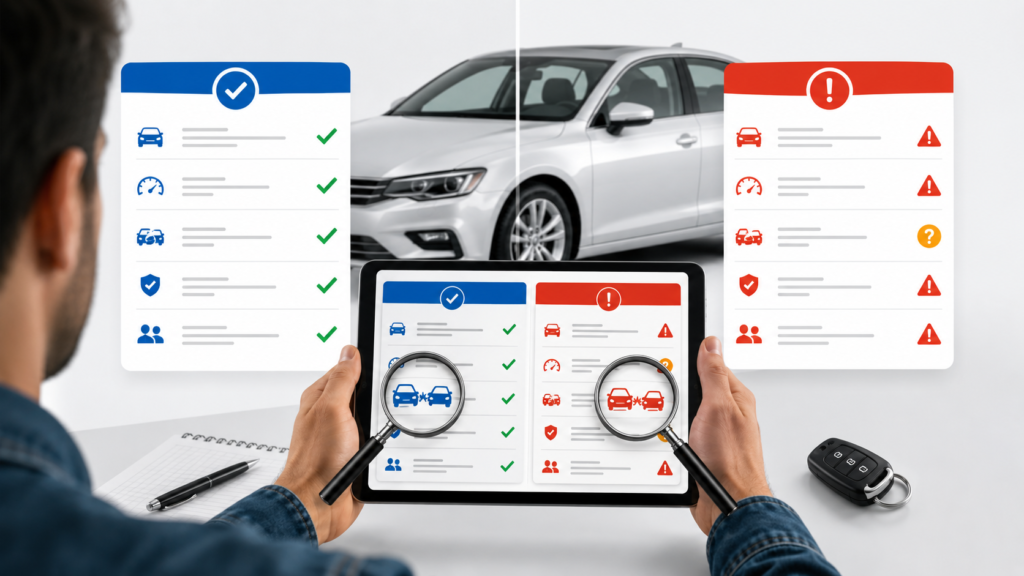
If you’re buying a used car, you’ll run into two names for vehicle history reports: Carfax and AutoCheck. Both pull from billions of records, both flag accidents and title problems, and both charge for the privilege. But they’re not interchangeable — they differ in data depth, presentation, price, and who they’re really built for. Here’s the honest comparison, updated with 2026 prices.
The short answer
For an individual buyer evaluating a specific car, Carfax is the more complete report, mainly because of its service and maintenance records — the section that best predicts long-term reliability. AutoCheck’s strength is auction data and its quick comparison “score,” which is why dealers use it to grade trade-ins in bulk. If you’re checking one car you might actually buy, Carfax tells you more. The catch has always been the price — and that part is solvable (more on that below).
2026 prices at a glance: one Carfax report costs $44.99 on Carfax.com. One AutoCheck report costs $29.99, or $59.99 for five reports used within 21 days. Through CarfaxDeals, a discounted Carfax report costs $5, and it’s the same official document.
What they have in common
Both reports draw on core public and industry sources: state DMV title and registration records, insurance total-loss reports, odometer readings at title transfers and inspections, recall databases, and reported accidents. For headline events — a salvage title, a reported severe crash, a rollback — a car that’s dirty on one report is usually dirty on the other.
Where they differ
| Factor | Carfax | AutoCheck |
|---|---|---|
| Company | Carfax, Inc. | Experian, the credit bureau |
| Service records | Extensive — dealer and independent shop visits, oil changes, repairs | Much thinner coverage |
| Accident detail | Detailed entries, often with severity and damage location | Reports incidents, generally less descriptive |
| Auction history | Included, less emphasized | Strong — Experian says it has data from 95% of U.S. auction houses |
| Scoring | No single score; full narrative report | AutoCheck Score (1–100), shown against a range for similar cars |
| Buyback program | Buyback Guarantee for DMV title brands the report missed | Buyback Protection for missed state title brands; register within 90 days of purchase |
| Retail price | $44.99 for one; $64.99 for 3; $99.99 for 6 | $29.99 for one; $59.99 for 5 used within 21 days |
| Best for | Individual buyers evaluating one specific car | Dealers and volume buyers screening many cars fast |
Why service records decide it
Title brands and reported crashes are the headline items, but most used cars have neither. What separates a good used car from a money pit is usually maintenance — and that’s exactly where Carfax’s data advantage lives. A report showing five years of on-schedule oil changes, a timing belt done at the right mileage, and brake work at sensible intervals tells you how the car was treated. AutoCheck simply doesn’t surface this layer with the same depth, which is a real gap when you’re about to hand a stranger $15,000. (For a full walkthrough of what those records mean, see our guide on how to read a Carfax report.)
Those records come from the dealers, repair shops and other sources that report to Carfax, and not every shop reports. Here’s how Carfax gets its information, and why some visits never show up.
The AutoCheck Score: useful, but know its limits
AutoCheck condenses a vehicle’s history into a single number from 1 to 100 and shows the typical range for similar cars of the same age and class. Higher is better, but the range matters more than the number: a score inside the range is typical for that kind of car, and a score above it is better than typical. It’s genuinely handy for triage — a dealer scanning forty auction cars doesn’t have time to read forty narratives. But for a buyer, a score is a summary of a summary: it can’t tell you which incident dinged the number or whether it’s the kind you can live with. You still end up reading the details, which puts you back where a narrative report started.
Buyback guarantees: what they really cover
Both companies back their reports with a buyback program, and both are narrower than the name suggests. AutoCheck Buyback Protection applies when the report missed a state title brand that had already been reported to Experian: you register the car within 90 days of buying it, and a valid claim pays up to 110% of the J.D. Power NADAguides retail value, plus up to $500 for aftermarket accessories. The Carfax Buyback Guarantee works on the same idea for DMV title brands the report missed, such as salvage, flood or lemon titles. Neither one covers accidents or mechanical problems, which is one more reason to pair either report with an inspection.
Which one do dealers use?
Both, for different jobs. Many dealers link a free Carfax report on their retail listings, because shoppers know the name and the service history builds trust. Auctions and wholesale buyers lean on AutoCheck for its auction coverage and one-number score. If a dealer only shows you one of the two, it’s fair to ask for the other, or to run it yourself.
The price problem — and the fix
The standard advice used to be: “AutoCheck if you’re checking lots of cars (cheaper), Carfax for the final candidate (deeper).” That trade-off existed purely because of Carfax’s $44.99 retail price. It disappears when the price does: CarfaxDeals sells the same official Carfax report for $5, and bundles bring it down to $3.20 per report. That’s well under the roughly $12 per report in AutoCheck’s 5-pack, and you still get the deeper report. At that price, you can run the better report on every car on your shortlist, not just the finalist.
Should you ever buy both?
For an expensive purchase where something feels off — say the seller’s story doesn’t quite match the paperwork — running both reports is cheap insurance, since each occasionally catches a record the other missed (AutoCheck’s auction entries, Carfax’s service visits). For a normal purchase, one thorough report plus a $100–150 pre-purchase inspection by an independent mechanic beats two reports and no inspection every time. Paper can’t hear a rod knock.
Weighing other report sellers too? Read Carfax vs Bumper, Carfax vs EpicVIN and Carfax vs carVertical.
Bottom line
- Buying one specific car? Carfax — the service history depth matters most for your decision.
- Screening many cars professionally? AutoCheck’s score and auction data make volume triage fast.
- Worried about the price gap? It’s gone — a Carfax report for $5 undercuts both AutoCheck’s $29.99 and Carfax’s own $44.99.
Carfax vs AutoCheck FAQ
Is AutoCheck better than Carfax?
Not for most private buyers. AutoCheck is better for screening many cars quickly, thanks to its auction data and single score. Carfax is better for judging one specific car, because its service and maintenance history goes much deeper.
Is AutoCheck cheaper than Carfax?
At retail, yes: $29.99 for one AutoCheck report versus $44.99 for one Carfax report, and $59.99 for five AutoCheck reports versus $64.99 for three from Carfax. Through CarfaxDeals, a Carfax report is $5, which beats both.
Can a car have a clean AutoCheck but a bad Carfax?
Yes. The two companies collect data from overlapping but different sources, so a body-shop visit or police report can reach one and not the other. Experian says most of the auctions it works with give it exclusive structural-damage announcements, while Carfax has the deeper service and repair network. If anything about a car feels off, check both.
Does AutoCheck show service records?
Only sparsely. AutoCheck concentrates on title, accident, odometer and auction records. Oil changes, scheduled maintenance and repair visits are where Carfax has far more data. See what a Carfax report shows for every section.
What is a good AutoCheck Score?
There’s no universal good number. The score runs from 1 to 100, and each report shows a range for similar vehicles of the same age and class. A score inside that range is typical, above it is better than typical, and below it means something in the history deserves a closer look.
Still skeptical that a $5 report can be real? Fair question — we answered it in detail: Is a cheap Carfax report legit?