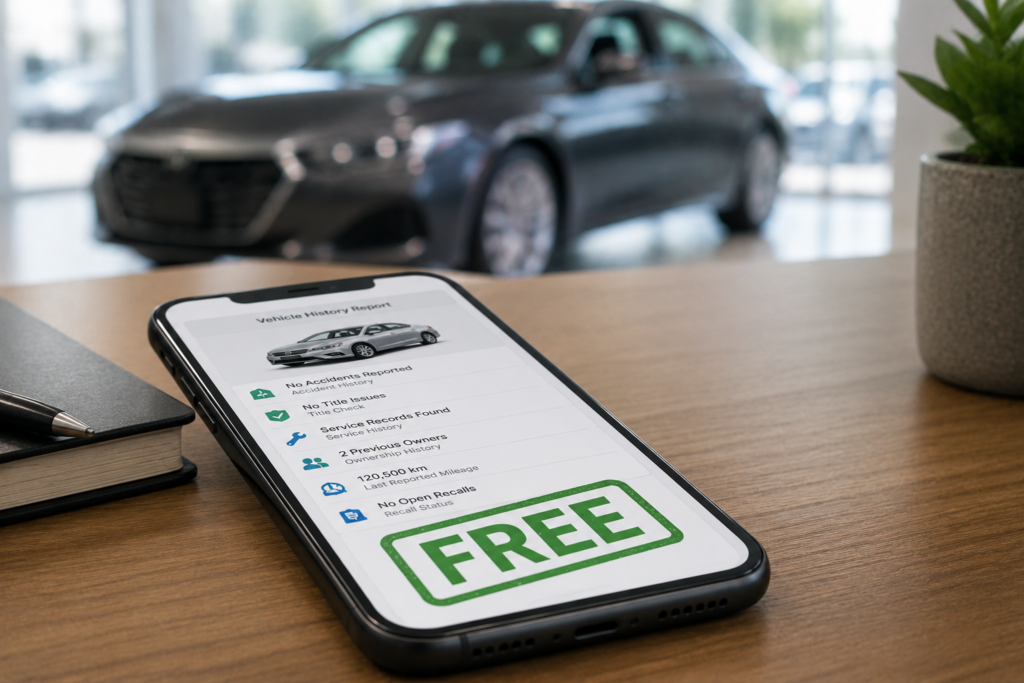
“Free Carfax report” is one of the most-searched phrases in used-car buying, and the honest answer is: mostly no, with a few real exceptions. Carfax sells reports for $44.99 — giving them away isn’t the business model. But there are legitimate ways to see one without paying, several free checks that cover part of what a report contains, and a few “free Carfax” offers that are actually traps. Here’s the complete picture.
The legitimate ways to see a Carfax report free
1. Dealer listings that include one
Many dealerships pay for Carfax subscriptions and attach a free report link to their online listings — look for a “View the Free Carfax Report” badge on the listing page (AutoTrader, Cars.com, and dealer sites). This is a real, full report, and it’s the single best free option. The limitation is obvious: it only exists for cars at dealers who pay for it. Private-party cars — where history checks matter most, because there’s no dealer reputation on the line — almost never come with one.
2. Asking the seller for one
A private seller or small dealer may have already bought a report and will happily forward it. Useful — but treat a seller-provided report as a starting point, never proof. PDFs are trivially easy to edit, and the report may be months old, predating a recent accident. A seller-provided report that looks clean plus a fresh cheap Carfax report you pull yourself for $5 is the safe combination; if they don’t match, you’ve just learned everything you need to know about the seller.
3. Carfax’s own free tools
Carfax gives away slices of its data to market the full product: a free basic VIN check on their used-car listings, myCarfax service reminders for a car you already own, and free flood/recall lookups they promote seasonally. Genuinely free, genuinely useful — and deliberately incomplete. None of them show the full accident, title, and ownership history of an arbitrary VIN you’re about to buy.
What you can check free on any VIN (no Carfax needed)
A meaningful chunk of a vehicle’s story is in public databases you can query for nothing:
- Factory identity — decode any VIN free to confirm year, make, model, trim, and engine match the listing. Our free VIN decoder pulls it straight from the government’s NHTSA database.
- Open safety recalls — every recall campaign, with the free fix, via our recall checker.
- Theft and total-loss records — NICB’s free VINCheck covers insurance-declared total losses and theft records.
Run all three on every car you’re considering; they cost nothing and kill the worst deals immediately. What they don’t cover is the layer that decides most purchases: accidents below total-loss severity, odometer readings over time, number of owners, and service history.
The “free Carfax” traps
- Fake report generators. Sites promising a “free full Carfax” that produce an official-looking PDF stuffed with generic data. If the recalls on it don’t match the official NHTSA database, it’s fiction.
- $1 trial → subscription. The teaser report that quietly enrolls you in a ~$30/month membership buried in the checkout terms. Legitimate services charge per report, once.
- Phishing forms. “Enter your card for the free report” — the product is your card number. No real free offer needs payment details.
Coupon codes aren’t much help either: Carfax rarely publishes them, and most offers you’ll find online are expired. Our Carfax coupon codes guide covers what actually works.
The honest math: free where possible, $5 where it counts
Here’s the thing the “free report” hunt misses: the reason people want it free is the $44.99 price tag, not the $5 one. The full official Carfax report — accidents, title brands, odometer table, owners, service records — costs $5 through CarfaxDeals, or $3.20 per report in bundles. (How a $5 Carfax can be real is a fair question; we answered it in full here: Is a cheap Carfax report legit?)
So the optimal playbook for a used-car search in 2026:
- Free: VIN decode + recall check + NICB on every candidate. Grab the dealer’s free Carfax link when a listing has one.
- $5: a fresh full report on every car that survives the free checks — pulled by you, not the seller.
- $100–150: a pre-purchase inspection on the finalist, because paper can’t compression-test an engine.
Total history-checking cost for a three-car shortlist: about the price of lunch — instead of $135 at retail, or worse, skipping the check and discovering the flood title after the money’s gone. When your reports arrive, our guide on how to read a Carfax report shows you exactly which sections kill deals.