Type “free VIN check” into Google and you’ll find two kinds of results: genuinely free government-backed lookups, and marketing funnels wearing the word “free” as bait. This guide is the complete inventory of the first kind — every check you can run on any VIN without paying a cent, what each one actually covers, and the one layer of a car’s history that no free source will ever show you.
The three real free VIN checks
1. Specs decode — what the car actually is
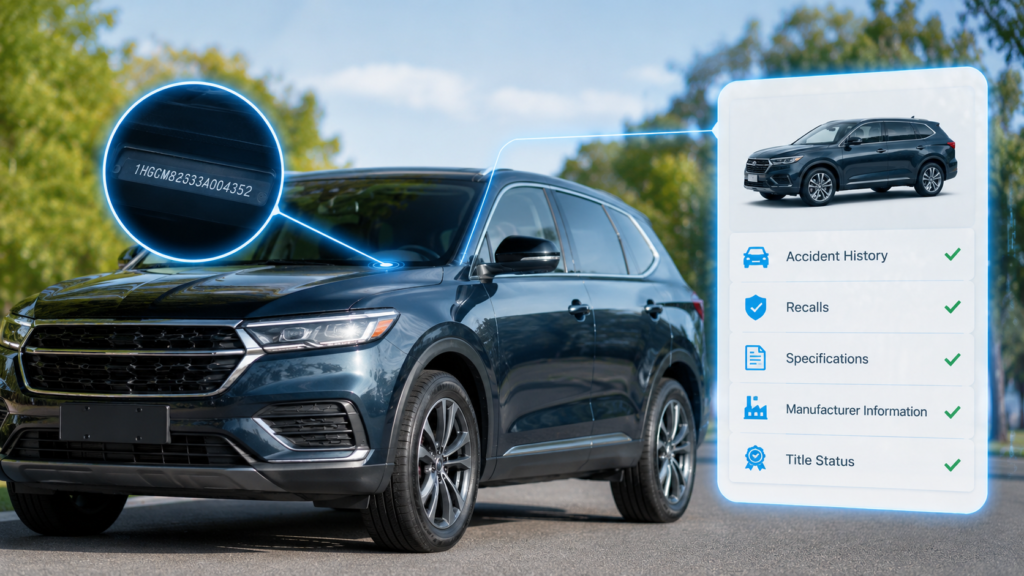
The federal government’s NHTSA vPIC database decodes any VIN into its factory identity: year, make, model, trim, body style, engine, drivetrain, and assembly plant. Run it through our free VIN decoder. This is the listing lie-detector — when an ad says “2019 EX-L V6” and the VIN decodes as a 2017 four-cylinder LX, you just saved yourself the drive. (Curious how the decode works? Here’s what each of the 17 characters means.)
2. Recall lookup — open safety campaigns
Every safety recall issued for the vehicle, with the component, the risk, and the remedy — and every recall repair is free at franchised dealers, by federal law, forever. Check any VIN with our free recall checker; the full how-to (including how to get the free repair booked) is here: how to check recalls by VIN.
3. NICB VINCheck — theft and total-loss records
The National Insurance Crime Bureau runs a free lookup covering two things: vehicles reported stolen and not recovered, and vehicles declared a total loss by participating insurers. Narrow, but the two things it covers are deal-enders. A car flagged here is a car you don’t buy — a stolen vehicle can be seized from you with no compensation.
Bonus free checks worth knowing
- Dealer listing reports. Many dealer listings on AutoTrader and Cars.com include a free full Carfax link — always click it when it exists. Full rundown of every free-report route: is there a free Carfax report?
- State title verification. Several states offer free or near-free online title status checks against their DMV records — worth a search for your state, especially for verifying a seller actually holds clean title.
- The seller’s own paperwork. Free and underrated: match the VIN across the dashboard plate, door sticker, and title — mismatches are the biggest red flag in used-car buying. Here’s every VIN location to compare.
The original window sticker. For many recent Ford, GM and Stellantis vehicles, the automaker’s own website returns the original window sticker as a free PDF, with the car’s options and original price. Here’s how to get a window sticker by VIN.
What the free layer covers — and the gap it leaves
| Question | Free check that answers it |
|---|---|
| Is the car what the listing claims? | VIN decode |
| Does it have open safety recalls? | Recall lookup |
| Is it stolen or insurer-totaled? | NICB VINCheck |
| Was it in an accident that wasn’t a total loss? | None |
| Has the odometer been rolled back? | None |
| How many owners, and how was it used? | None |
| Salvage/flood/rebuilt title in its past? | Only if insurer-totaled; title washing can hide it |
| Was it maintained? | None |
That bottom half of the table is where used-car money is actually lost — the fender-bender that bent something structural, the vanished 60,000 miles, the flood title laundered through a lenient state. Those records live in commercial history databases, and accessing them always costs something. The only question is whether it costs $44.99 or $5 for a discounted Carfax report from CarfaxDeals — the same official report, minus the retail markup.
The zero-waste checking workflow
Run the three free checks on every car you’re considering — two minutes each, and they eliminate the outright frauds and stolen vehicles for nothing. Any car that survives and still interests you gets the $5 full report before you commit to a test drive across town. The car that survives that gets a $100–150 pre-purchase inspection. Total research cost for a serious three-car search: under $20 in reports — versus the $135 it would cost at retail, or the four-figure repair bill it costs to skip checking entirely. When your report arrives, here’s how to read every section of it.