A Carfax report can tell you that a car was in an accident three years ago, had its oil changed a dozen times and was registered to a rental company before its current owner. So where does all that information come from? Here’s how Carfax gets its data, how it knows a car’s mileage, which shops report to it — and what it can’t know.
How does Carfax get its information? The quick answer
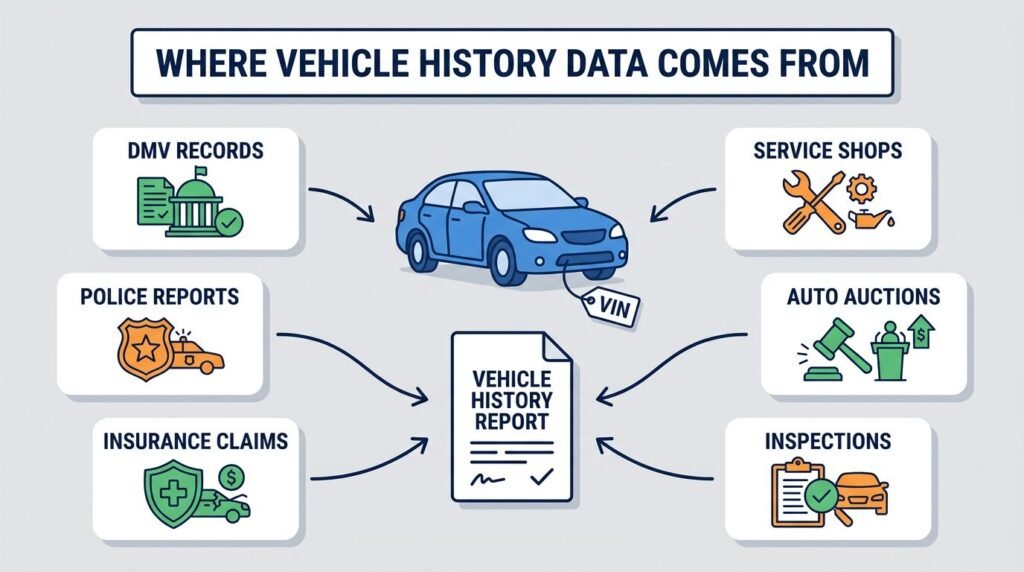
Carfax doesn’t inspect cars. It collects records that other organizations create about a vehicle — every time a car is titled, registered, inspected, serviced, auctioned, reported in an accident or claimed on insurance — and matches each record to the car’s 17-character VIN. When you buy a report, Carfax pulls together every record tied to that VIN in date order. Carfax says it draws on more than 35 billion records from over 150,000 sources across the U.S. and Canada.
Where Carfax gets its information
- State DMVs — title and registration records from every U.S. state, plus Canadian provincial records: ownership changes, title brands such as salvage or flood, and odometer readings at title transfer.
- Police and fire departments — accident and fire reports where they’re shared.
- Insurance companies — some claims, total-loss records and theft records.
- Service and repair shops — dealership service departments and many independent shops and chains report maintenance and repairs.
- Collision repair facilities — body shop repair records.
- Auto auctions — sale records, condition announcements and disclosed damage.
- State inspection stations — safety and emissions inspections, with odometer readings.
- Rental and fleet companies — which is how a report can show a car was a rental or company car.
- Manufacturers — recall information and manufacturer buybacks.
- Dealers, extended-warranty companies and import/export records.
How Carfax works, step by step
- Something happens to the car — an oil change, a registration renewal, a fender-bender.
- A source records it with the VIN — the shop’s invoice, the DMV record or the police report.
- The source shares the record with Carfax — usually in regular data feeds, so there can be a delay.
- Carfax matches the record to the VIN and adds it to the vehicle’s history.
- You run a report, such as a cheap Carfax for $5, and see every matched record in order, with summaries for accidents, owners, title, service and mileage.
How does Carfax know my mileage?
Mileage on a Carfax report comes from odometer readings recorded by its sources — at oil changes and repairs, state inspections, title transfers, registrations, auctions and some dealer visits. Each reading is stored with a date, so Carfax can show the trend over time and flag problems. If a later reading is lower than an earlier one, the report can flag a potential rollback. Learn how that works in what is odometer rollback?
Does Jiffy Lube report to Carfax? What about Valvoline?
Many Jiffy Lube locations report service visits to Carfax, and some Valvoline and other quick-lube locations do too — but it varies from shop to shop, especially where locations are independently owned franchises. If you want an oil change to show up on your car’s history, ask the shop whether it reports to Carfax, and keep the receipt with the VIN, date and mileage either way. Service records can be missing simply because the shop never sent them.
How far back does Carfax go?
Carfax reports are available for cars and light trucks from model year 1981 onward — the year the 17-character VIN became standard. A report can cover a car’s whole life from its first title, but records from its early years are often thinner, simply because fewer sources reported electronically back then.
What Carfax can’t know
Carfax only knows what gets reported to it. A few common gaps:
- Accidents with no police report or insurance claim — for example, a crash the owner paid to fix privately.
- Repairs at shops that don’t report — many small independent shops don’t send data.
- Very recent events — records can take days or weeks to arrive.
- The car’s current mechanical condition — a history report is not an inspection.
That’s why a clean report is a good sign but not a guarantee — see is Carfax reliable? and what “clean Carfax” means.
The bottom line
Carfax builds each report by matching records from DMVs, police, insurers, auctions, service shops and other sources to a car’s VIN. That makes it a powerful record of what’s been reported — titles, owners, mileage, service and accidents — but not a complete picture of everything that ever happened to the car. Read the report, then confirm it with an inspection. Not sure what each section means? Start with what does Carfax show?