
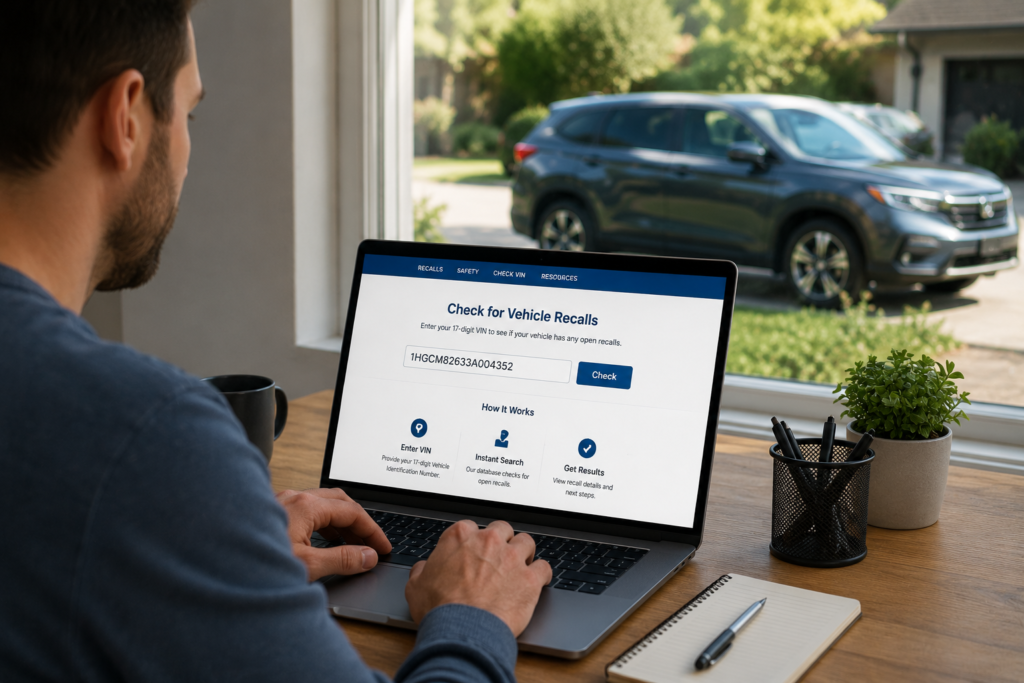
Here’s a fact that surprises most car owners: safety recall repairs are free, forever. Not “free during warranty” — free at any franchised dealer for that brand, regardless of the car’s age, mileage, or how many owners it’s had. The manufacturer pays, by federal law. The only catch is that nobody mails the fourth owner of a 2012 sedan a letter, so millions of cars drive around with open recalls their owners never heard about. Checking takes 30 seconds, and here’s exactly how.
Step 1: Get the VIN
The recall lookup runs on the 17-character Vehicle Identification Number. It’s on the driver’s-side dashboard (visible through the windshield), the driver’s door-jamb sticker, and the title and registration. Buying remotely? Ask the seller for a photo of the door-jamb sticker — full guide here: where to find your VIN.
Step 2: Run the lookup
Enter the VIN into our free recall checker. It identifies the exact year, make, and model, then pulls every safety recall campaign issued for that vehicle from the official NHTSA database — the same federal registry manufacturers are required to report to. For each recall you’ll see the component affected, the risk if unrepaired, and the remedy. No account, no payment, no limit.
Step 3: Read the results
- No recalls found — the model has no open safety campaigns. Note that brand-new recalls can take a few days to appear in the database after announcement.
- Recalls listed — don’t panic; read the component and risk. A recall on a trunk latch and a recall on airbag inflators are different conversations. Common serious ones to take seriously: airbag inflators (the Takata campaign is still being completed years later), fuel pumps, brake components, and anything described with “fire risk.”
One honest limitation to understand: recall databases match at the year/make/model level. A campaign may cover only certain production runs, and a listed recall may already have been repaired on this specific car. Which brings us to step 4.
Step 4: Confirm and book the free repair
Call any franchised dealer for the brand, give them the VIN, and ask two questions: “Does this VIN have open recalls?” (their system checks campaign completion per-VIN) and “When can you do the repair?” That’s it — no charge, no proof of purchase, no arguing. You didn’t need to buy the car there; you don’t even need to be the registered owner to ask.
If you’re buying a used car
Run the recall check on every candidate before you visit — it’s free intel, and it works as a negotiation and character test in one:
- Open recall on a serious component = a free repair appointment for you, and a data point about the seller: they ignored a free safety fix. What else did they skip? Their maintenance answers just became less credible.
- All recalls completed = a small green flag that the car was actually looked after.
Pair the recall check with a free VIN decode to confirm the car matches the listing’s claimed year, trim, and engine. Those two free checks catch the model-level problems. What they can’t see is this specific car’s life — the accident last spring, the flood title from another state, the 60,000 miles that vanished from the odometer. That layer is the full Carfax report, and a cheap Carfax check through CarfaxDeals costs $5 instead of $44.99 retail. It’s the difference between checking the model and checking the car.
Check your own car too
Not shopping? Run your own VIN right now anyway. Recalls are issued continuously — a car that was clean when you bought it may have gained a campaign since, and if you’re not the original owner, the manufacturer’s notification letter went to someone else’s mailbox. Thirty seconds, free, and occasionally it’s the thirty seconds that gets an exploding airbag inflator out of your steering wheel: check your VIN for recalls.