
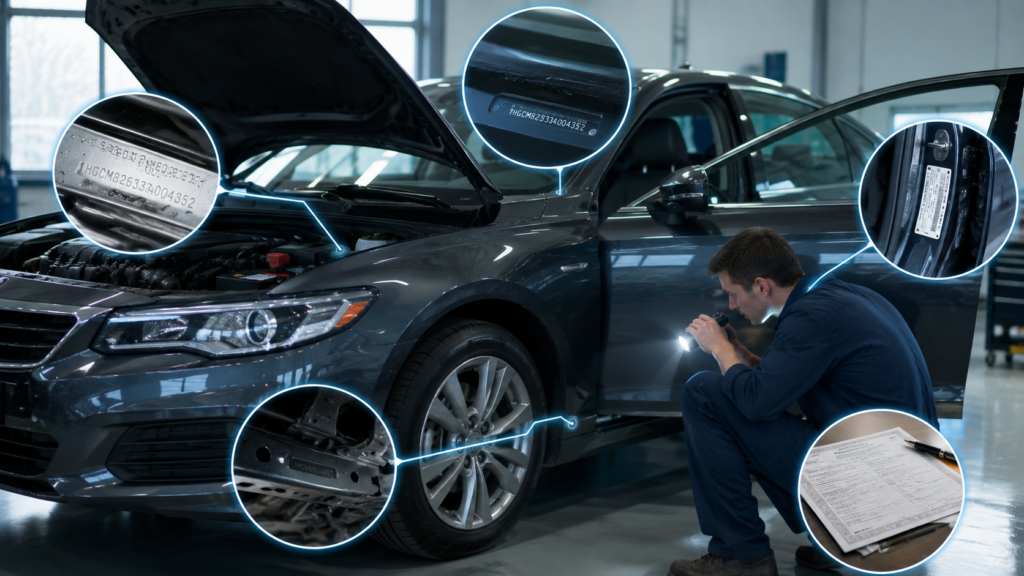
Every task in used-car buying starts with the same 17 characters: decoding the specs, checking recalls, running a cheap Carfax check, verifying the title. So the first practical skill is simply knowing where the VIN lives — and just as importantly, checking that it says the same thing in every location. Here’s the complete map.
On the car itself
1. Dashboard, driver’s side (the main one)
Stand outside the car and look through the windshield at the bottom corner of the dashboard on the driver’s side. There’s a small metal plate stamped with the VIN, positioned to be readable from outside. This is the primary location on every vehicle sold in the U.S. since 1969, and the one police, insurers, and inspectors check first.
2. Driver’s door jamb sticker
Open the driver’s door and look at the edge of the door or the B-pillar (the frame the door latches to). The manufacturer’s label there carries the VIN along with the build date, tire pressure specs, and paint code. This is the easiest one to read up close and the one you’ll photograph when a listing asks for it.
3. Engine bay
Most manufacturers stamp or sticker the VIN somewhere in the engine compartment — on the firewall, the strut tower, or a plate riveted near the front. Location varies by brand, but it’s there.
4. Frame and hidden stampings
The VIN is also stamped directly into the chassis in locations manufacturers don’t publicize — under carpeting, on the frame rail, under the spare tire well. These hidden stampings exist precisely because they’re hard for thieves to alter, which is why they matter (more on that below).
On the paperwork
The VIN must also appear on the title, the registration, and the insurance card — and on newer cars you can usually pull it up on the infotainment screen in the settings menu. When you’re buying, the paperwork VINs are half of the verification: the documents prove what car the seller legally owns; the stampings prove what car is physically in front of you.
The check that actually matters: do they all match?
Finding the VIN is easy. The real skill is comparing: dashboard plate vs door sticker vs title, character by character. On a legitimate car they’re identical. When they’re not, you’re looking at one of two situations, and both end the deal:
- VIN cloning — a stolen car wearing the identity of a clean one. Thieves copy the VIN from a legally registered vehicle of the same make/model and put replica plates on a stolen twin. The dashboard plate may look perfect; the door sticker (harder to fake well) or hidden frame stampings give it away. If you buy a cloned car, it can be seized with no compensation — you inherit the loss.
- Rebuilt from parts — a car assembled from two wrecks, wearing the front half of one and the identity of another. The mismatched stampings are the seam.
Also inspect the dashboard plate itself: it should sit flush under the windshield with factory rivets. Scratches around it, mismatched rivets, or a plate that looks newer than the car are tampering signs.
Reading a VIN from a listing photo
When shopping online, ask the seller for a photo of the door-jamb sticker before driving anywhere — any legitimate seller takes it in ten seconds. With the VIN in hand you can do the entire desk-check remotely: run it through our free VIN decoder to confirm the car is the year, trim, and engine the ad claims (a “2019 EX-L” that decodes as a 2017 LX is a listing you close immediately), check open recalls, and pull the history. A seller who refuses to share the VIN “until you come see it” is telling you the history has something in it.
Then put the VIN to work
Once you’ve confirmed the VIN is consistent everywhere, the 17 characters become your research key: free decode, free recall check, and the full history — accidents, title brands, odometer readings, owners — via a Carfax report for $5 instead of the $44.99 retail price. Curious what the characters themselves encode? That’s its own story: what the 17 characters in a VIN actually mean.