
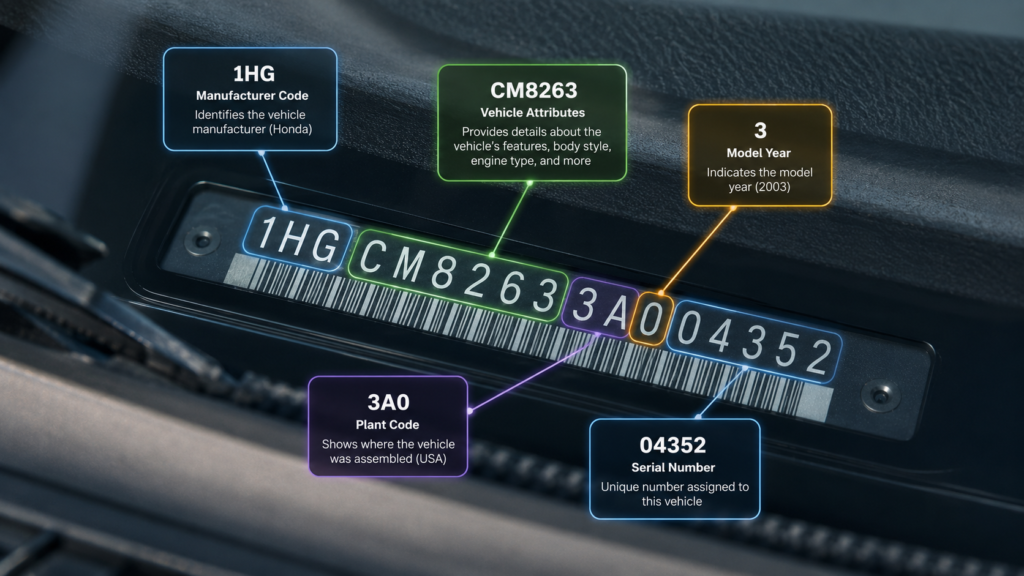
A Vehicle Identification Number looks like random noise — 1HGCM82633A004352 — but it’s actually a structured code where every position means something specific. Learn the structure once and you can read a car’s origin, specs, and model year straight off the dashboard plate, and spot listings that don’t add up before wasting a trip. Here’s the full breakdown.
The three sections of every VIN
Since 1981, every VIN is exactly 17 characters, organized into three blocks:
| Positions | Name | What it encodes |
|---|---|---|
| 1–3 | WMI (World Manufacturer Identifier) | Country and manufacturer |
| 4–9 | VDS (Vehicle Descriptor Section) | Model, body, engine, restraints + check digit |
| 10–17 | VIS (Vehicle Identifier Section) | Model year, plant, and serial number |
Positions 1–3: who built it, and where
Position 1 is the country of final assembly. The common ones: 1, 4, 5 = United States, 2 = Canada, 3 = Mexico, J = Japan, K = South Korea, S = United Kingdom, W = Germany, Y = Sweden/Finland. So yes — a “Japanese” Honda starting with 1 was built in America, which is normal (most U.S.-market Accords are Ohio-built).
Positions 2–3 identify the manufacturer: 1HG = Honda USA, 1FT = Ford trucks, WBA = BMW, JTD = Toyota Japan, KM8 = Hyundai. There are thousands of codes, which is why nobody memorizes them — a free VIN decoder resolves them instantly.
Positions 4–8: the spec sheet
These five characters are the manufacturer’s own code for the model, body style, engine, transmission, and restraint system. Each brand uses its own scheme, so the same characters mean different things at Honda vs Ford — but within a brand they’re precise. This is the section that catches spec lies: when a listing says “V6 Touring” and the decode of positions 4–8 comes back as the four-cylinder base model, the discrepancy is written into the car’s DNA. Sellers can lie in an ad; they can’t edit the VIN.
The VIN gives you the basic spec. For the full list of factory options and the original price, look up the car’s window sticker by VIN.
Position 9: the check digit (the fraud detector)
Position 9 isn’t information — it’s math. It’s calculated from all the other characters using a weighted formula defined by federal regulation. Change any single character in the VIN and the check digit no longer computes, which makes it the first line of defense against typos and crude VIN tampering. If a decoder rejects a VIN as invalid, this is usually the character that snitched. (One quirk worth knowing: the letters I, O, and Q are never used in any position, to avoid confusion with 1 and 0 — a “VIN” containing them is mistyped or fake.)
Position 10: the model year
One character encodes the model year on a rotating 30-year cycle: A = 2010, B = 2011 … H = 2017, J = 2018 (I is skipped), K = 2019, L = 2020, M = 2021, N = 2022, P = 2023, R = 2024, S = 2025, T = 2026. Digits 1–9 covered 2001–2009. This is the fastest manual check there is: a claimed “2020” whose tenth character isn’t L is not a 2020.
Position 11: the assembly plant
A single manufacturer-specific code for the factory. Mostly trivia for buyers — but occasionally relevant when a recall or known defect affected only certain plants’ production runs.
Positions 12–17: the serial number
The final six characters are the sequential production number — this specific car’s place in the line. Combined with everything before it, that’s what makes a VIN globally unique, and why it works as the key to every database: titles, insurance claims, recalls, and history reports.
From reading the VIN to reading the car
Decoding tells you what the factory built: use our VIN decoder for the full spec sheet and the recall checker for open safety campaigns — both free. But the VIN’s real power is as a lookup key into the car’s life: the accidents, title brands, odometer readings, and owners recorded against those 17 characters over the years. That’s the cheap Carfax report — $5 through CarfaxDeals instead of $44.99 retail. First step either way: find the VIN and make sure it matches everywhere on the car — here’s every location to check.