Buying from a private seller instead of a dealer can save you real money — no dealer markup, no add-on fees, and more room to negotiate. But it also means no dealer protections, no warranty, and no one to go back to if something’s wrong. The car is sold as-is, and the risk is yours.
That trade-off is worth it if you do it carefully. Here’s how to buy a used car from a private seller safely, step by step.
Step 1: Verify the car’s history before you meet
Before you drive across town, get the VIN from the seller and run a low-cost Carfax report. This is even more important with a private sale than a dealer, because there’s no dealership reputation on the line — the report is your independent check on what the seller tells you. It reveals reported accidents, title brands (salvage, flood, rebuilt), odometer discrepancies, and how many owners the car has had.
If the seller won’t provide a VIN, that’s a red flag — a legitimate seller has no reason to hide it. (Not sure what you’re looking for? Here’s where to find the VIN.)
Step 2: Confirm the seller actually owns the car
This is the step that protects you from the most serious scams. Before anything else:
- Check the title. The name on the title must match the seller’s photo ID. If the seller “is selling it for a friend” or the name doesn’t match, stop — this is how stolen and curbstoned cars are sold.
- Match the VIN. The VIN on the title must match the VIN on the dashboard and door jamb. A mismatch can indicate a cloned or stolen vehicle. Then decode the VIN to confirm the year, model and engine match the ad.
- Check for liens. Make sure the car isn’t still being financed. If there’s a lien, the lender — not the seller — technically holds the title until it’s paid off.
Step 3: Inspect the car and test drive it
Go through a full inspection in daylight, and never skip the test drive. Use our used car inspection checklist to cover the exterior, interior, engine, and drive systematically. With a private sale especially, take your time — there’s no return policy to fall back on.
For any car you’re serious about, get a pre-purchase inspection from an independent mechanic. A seller who refuses to allow one is telling you something.
Step 4: Meet safely
You’re meeting a stranger, often with cash involved. Protect yourself:
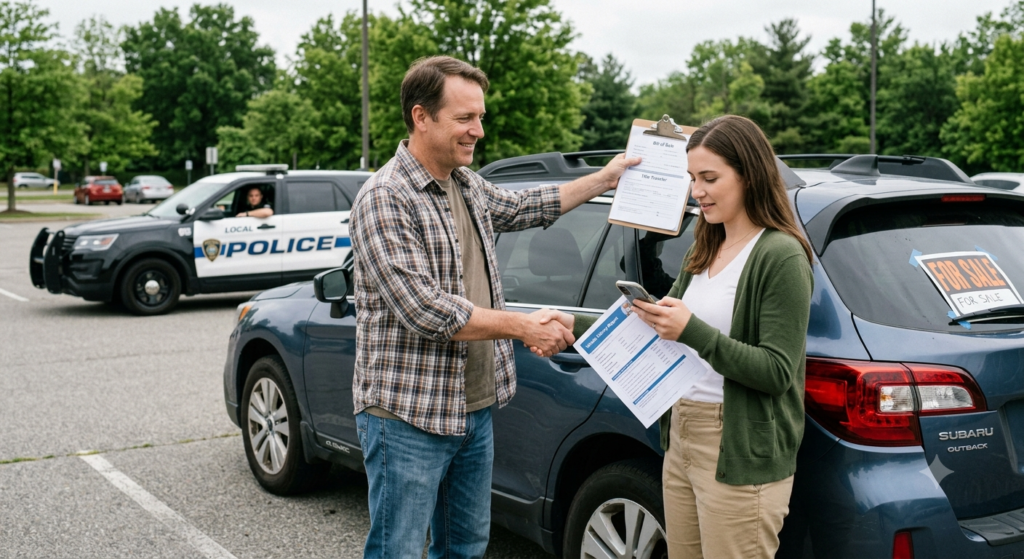
- Meet in a public, well-lit place — many police stations offer safe-exchange zones for exactly this.
- Bring someone with you.
- Meet during the day so you can actually see the car.
- Trust your instincts — if something feels off, walk away.
Step 5: Negotiate with facts
Private sellers are often more flexible than dealers. Use what you’ve found to negotiate: the history report, any issues from your inspection, and the mechanic’s findings all give you leverage. Come with a number backed by research, not just a lowball.
Step 6: Handle payment and paperwork correctly
- Payment: For large amounts, a cashier’s check or bank transfer is safer than carrying cash. Never pay before you have the signed title in hand.
- Bill of sale: Create one showing the price, date, VIN, and both parties’ names and signatures. Many states provide a template.
- Title transfer: The seller signs the title over to you. Check your state’s DMV requirements — some require the transfer to be notarized.
- Registration: Transfer the title and register the car in your name promptly, and don’t drive it without insurance.
Red flags to walk away from
- The name on the title doesn’t match the seller’s ID
- The seller won’t provide the VIN or won’t allow an inspection
- The price is far below market with no good explanation
- The seller pressures you to pay quickly or wire money before you see the car
- The VIN on the car doesn’t match the title
The bottom line
Buying from a private seller is safe when you verify three things: the car’s history, the seller’s ownership, and the car’s condition. Run the history report before you go, confirm the title matches the seller, inspect thoroughly, and handle the paperwork by the book. Do that, and a private sale can get you a better car for less than a dealer would ever offer.
Check the VIN and run a full history report for $5 before you buy →