
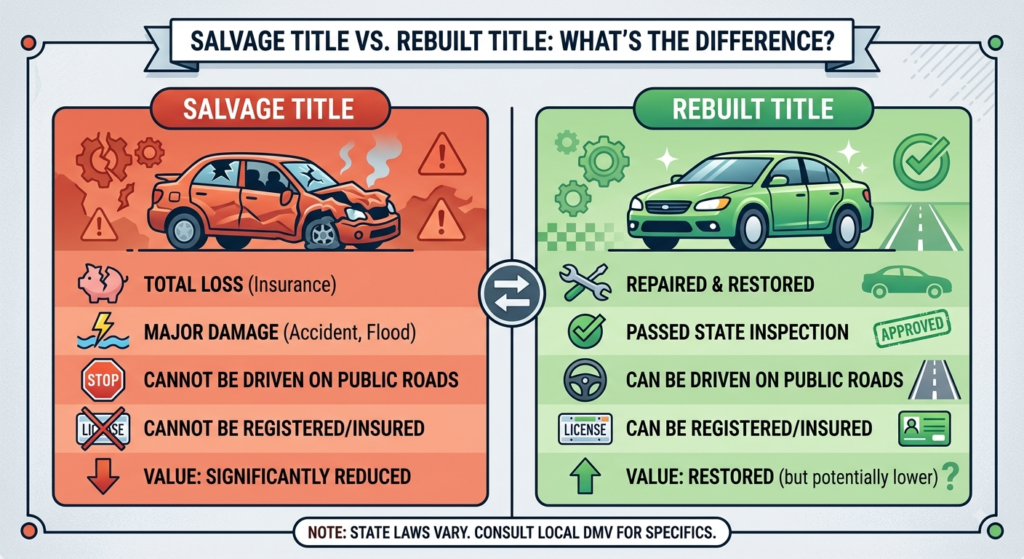
If you’re shopping used cars, sooner or later you’ll see a bargain with a salvage or rebuilt title — priced well below everything else. These two terms get used interchangeably, but they mean very different things, and confusing them can cost you. Here’s a clear breakdown of salvage vs. rebuilt titles and what each means for you as a buyer.
The short version
- Salvage title: The car was declared a total loss and has not been repaired or re-certified. In most states it cannot legally be driven on public roads.
- Rebuilt title: A salvage car that has since been repaired and passed a state inspection certifying it’s roadworthy again. It can be registered and driven — but the title permanently records that it was once salvage.
In plain terms: salvage means “totaled and not fixed,” rebuilt means “totaled, fixed, and re-approved.” If you’re buying a car to actually drive, you’re looking at a rebuilt title, not a salvage one.
What is a salvage title?
A state issues a salvage title when an insurance company declares a vehicle a total loss — usually because the cost to repair it exceeds 70–90% of its value (the exact threshold varies by state). This can happen from a collision, flood, hail, fire, or theft recovery.
A salvage-titled car is essentially in limbo: it’s been written off, and until it’s repaired and inspected, it can’t legally hit the road in most states. People buy salvage cars to rebuild them, part them out, or flip them — but you can’t just register one and drive away.
What is a rebuilt title?
A rebuilt (or “reconstructed”) title is what a salvage car earns after it’s been repaired and has passed a state-mandated inspection confirming it’s safe to drive. The inspection verifies the repairs and checks that no stolen parts were used.
A rebuilt-title car can be insured, registered, and driven legally. But the “rebuilt” brand stays on the title forever, and that carries real consequences — which brings us to the trade-offs.
Salvage vs. rebuilt: the key differences
| Salvage Title | Rebuilt Title | |
|---|---|---|
| Repaired? | No | Yes |
| Passed inspection? | No | Yes |
| Legal to drive? | No (in most states) | Yes |
| Can be insured? | Very limited | Usually, but may be restricted |
| Can be financed? | Rarely | Difficult; many lenders decline |
| Typical price vs. clean title | Much lower | 20–40% lower |
Should you buy a rebuilt-title car?
It can make sense — but only with your eyes open. A rebuilt-title car is worth considering if you’re buying it to drive for years (not resell soon), you know exactly why it was totaled, an independent mechanic has confirmed the repairs are sound, and you’ve sorted out insurance without relying on financing.
It’s a bad idea if you can’t verify the damage history, can’t get it professionally inspected, need a loan to buy it, or might need to sell in a few years — because you’ll face the same skepticism and steep discount you’re benefiting from now.
Be especially careful about why the car was totaled. Hail damage is cosmetic and low-risk; a frame-bending collision or a flood is a different story. If flooding is a possibility, read how to check for flood damage in a used car.
How to check a car’s title status
Never take a seller’s word on title status — verify it independently. Check a car’s title status with a discounted Carfax report, which shows salvage, rebuilt, flood, and lemon brands along with the accident and damage records behind them. That tells you not just what the title says, but why — the context you need to judge whether a rebuilt car is a smart buy or a money pit.
For a deeper look at how total-loss designations work, read what is a salvage title?
The bottom line
Salvage and rebuilt titles aren’t the same: salvage is a totaled car that hasn’t been fixed and usually can’t be driven, while rebuilt is one that’s been repaired and re-certified for the road. Rebuilt cars can be a legitimate bargain — but only after you’ve confirmed why the car was totaled and had it inspected. Whatever you’re considering, check the title status with a history report first, so you know exactly what you’re buying.