
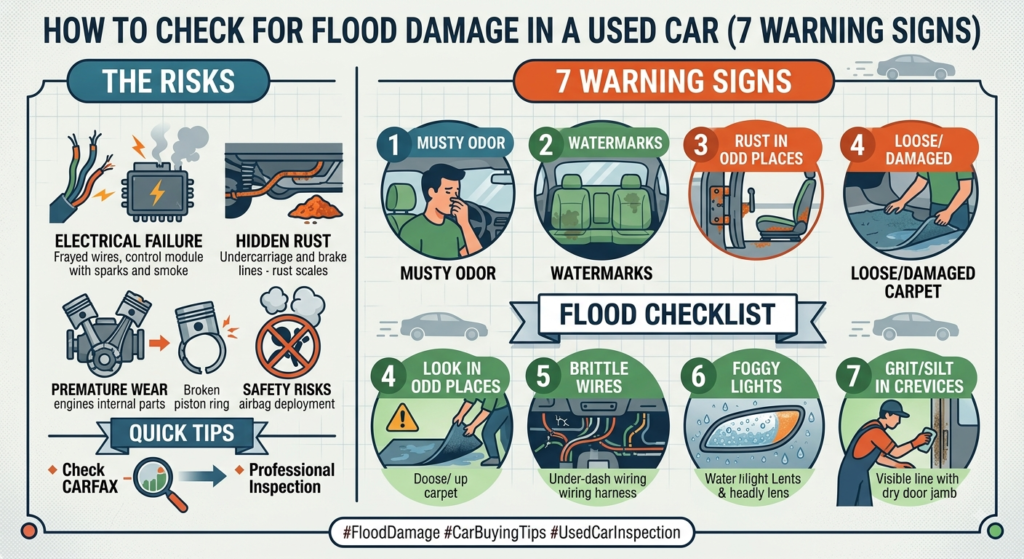
Every year, tens of thousands of flood-damaged cars are cleaned up, shipped to new states, and resold to buyers who never know what they’re getting. A flooded car can look and even drive fine at first — then the electrical gremlins, corrosion, and mold set in. Here’s how to catch flood damage before it becomes your problem.
Why flood-damaged cars are so dangerous to buy
Water is uniquely destructive to a modern car. It seeps into wiring harnesses, control modules, sensors, and connectors, causing corrosion that may not fail for months. It soaks into carpets, seats, and insulation, breeding mold that’s nearly impossible to fully remove. And it can compromise safety systems — airbags, ABS, and electronic stability control all rely on electronics that water quietly destroys.
The worst part: a flooded car is often title-washed — moved to a state with looser rules so its flood or salvage brand disappears from the paperwork. That’s why a visual inspection alone isn’t enough.
7 warning signs of flood damage
- A musty or moldy smell. The single most reliable sign. If the interior smells damp, musty, or like heavy air freshener trying to mask something, be suspicious.
- Water lines or silt. Look for faint discoloration lines on the interior, under the dash, or in the trunk. Check for dried mud or silt in hard-to-reach places — under the seats, in the spare-tire well, inside the glovebox.
- Mismatched or new upholstery. Brand-new carpet or seats in an older car, especially if they don’t match, can mean water-damaged originals were replaced.
- Rust in odd places. Surface rust on screws, brackets, door hinges, seat rails, or under the dashboard — areas that shouldn’t rust from normal use.
- Foggy or moisture-filled lights. Condensation inside headlights, taillights, or interior gauges points to water intrusion.
- Electrical problems. Test everything — windows, locks, lights, radio, gauges, warning lights, power seats. Intermittent or dead electronics are a classic flood symptom.
- Grit in unusual spots. Run your finger inside seat tracks and around wiring under the dash. Sand or dirt where it doesn’t belong is a red flag.
The step most people skip: check the VIN
Here’s the problem with relying only on your senses: a professionally cleaned flood car can pass a visual inspection, especially if the seller has had months to detail it. The reliable check is the paper trail.
Run a vehicle history report on the VIN before you buy. A history report can reveal flood or water-damage title brands, salvage designations, and insurance total-loss records — even if the seller has tried to hide them by moving the car to another state. It’s the one check that sees past a fresh detailing job.
If a report shows a flood or salvage brand, walk away no matter how clean the car looks. To understand how these title brands work, read what is a salvage title?
What to do if you suspect flood damage
- Get a professional inspection. An independent mechanic can spot corrosion and moisture damage you can’t. Combine it with our used car inspection checklist.
- Check the title carefully. Look for flood, water damage, salvage, or rebuilt brands. Match the VIN on the title to the car.
- When in doubt, walk. There are plenty of clean used cars. A flood car is never worth the risk, no matter how good the price.
The bottom line
Flood damage hides well — a detailed car can fool your eyes and nose. Trust the paper trail: run the VIN through a history report to catch flood and salvage brands the seller may have buried, and back it up with a professional inspection. At $5 a report, checking is far cheaper than inheriting someone else’s flooded car.