
You’re browsing used cars and spot one priced thousands below similar models. Then you see it: salvage title. Before you get excited about the deal — or scared off entirely — here’s exactly what a salvage title means, why these cars are so cheap, and whether buying one is ever a smart move.
What is a salvage title?
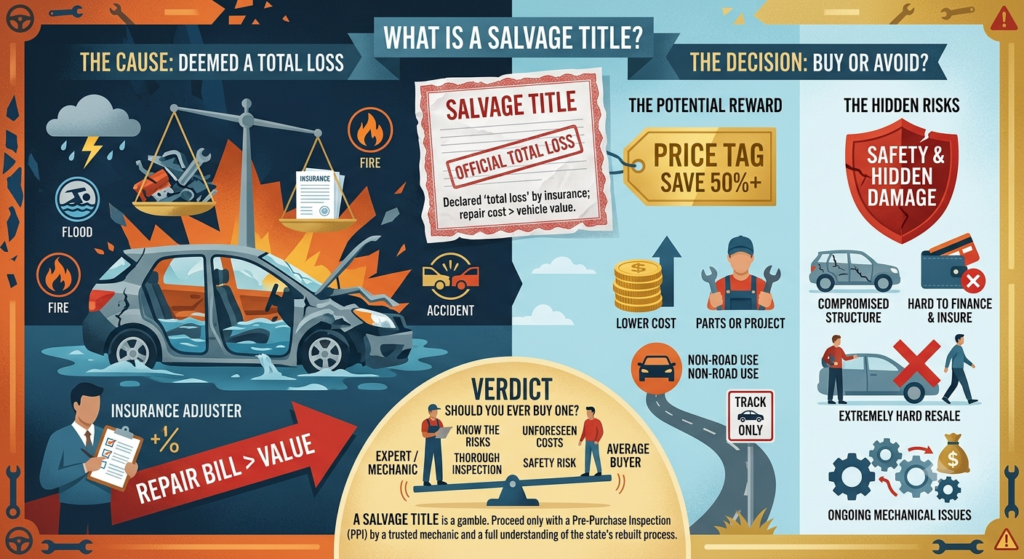
A salvage title is a designation a state issues when an insurance company declares a vehicle a total loss. That usually happens when the cost to repair the car exceeds a certain percentage of its value — often 70–90%, depending on the state.
Importantly, “total loss” doesn’t always mean the car was destroyed. A vehicle can be totaled by:
- A collision with significant damage
- Flood or water damage
- A hailstorm (cosmetic but expensive to fix)
- Theft and recovery (sometimes stripped, sometimes barely touched)
- Fire damage
So a salvage title tells you the car was declared a total loss — but not the whole story of what happened or how bad it really is. That’s why digging into the details matters so much.
Salvage title vs. rebuilt title: what’s the difference?
These two get confused constantly, but the difference is crucial:
- Salvage title: The car has been declared a total loss and has not been repaired or re-inspected. In most states, a car with an active salvage title can’t legally be driven on public roads.
- Rebuilt title (or “reconstructed”): A salvage vehicle that has since been repaired and passed a state inspection certifying it’s roadworthy again. It can be registered and driven — but the title permanently shows it was once salvage.
In short: salvage means “totaled and not yet fixed,” rebuilt means “totaled, fixed, and re-approved for the road.” You’ll almost always be buying a rebuilt title car if you’re buying one to drive.
Why are salvage/rebuilt title cars so cheap?
Cars with a salvage history typically sell for 20–40% less than a comparable clean-title vehicle. That discount reflects real downsides:
- Hidden damage. Repairs can hide problems rather than truly fix them — frame damage, electrical issues, or safety systems that don’t work as designed.
- Insurance headaches. Some insurers won’t offer full coverage on a rebuilt-title car, and those that do may limit it.
- Financing is hard. Many lenders won’t finance a salvage or rebuilt vehicle at all.
- Terrible resale value. When you go to sell, you’ll face the same skepticism — and the same steep discount — you’re benefiting from now.
- Safety uncertainty. A car that took a hard hit may have compromised crash protection even after repairs.
Should you ever buy a salvage title car?
Sometimes — but only with your eyes wide open. A rebuilt-title car can make sense if:
- You’re buying it to drive for years, not to resell soon
- You’ve confirmed why it was totaled (hail damage is very different from a frame-bending collision)
- An independent mechanic has inspected it thoroughly and confirmed the repairs are sound
- You’ve sorted out insurance and aren’t relying on financing
- The discount genuinely reflects the risk you’re taking on
It’s a bad idea if you can’t verify what happened to the car, can’t get it professionally inspected, need to finance it, or might need to sell it in a few years.
How to check for a salvage title before you buy
This is the part that protects you. Never rely on a seller’s word about a car’s title status — verify it independently:
- Run a vehicle history report. A history report will show title brands including salvage, rebuilt, flood, and lemon designations, along with reported accidents. Check any VIN for a salvage title before you get attached to a “deal.”
- Read the title document carefully. Look for the words salvage, rebuilt, reconstructed, or a brand stamp. Match the VIN on the title to the car.
- Get a professional inspection. For any salvage/rebuilt car, an independent mechanic on a lift is non-negotiable — use our used car inspection checklist as your guide.
A history report is the fastest way to catch a salvage title you weren’t told about — and to understand the accident and damage records behind it. Learn what those records look like in how to read a Carfax report.
The bottom line
A salvage title means an insurer declared the car a total loss; a rebuilt title means it was repaired and re-approved for the road. These cars are cheap for real reasons — hidden damage, insurance and financing hurdles, and poor resale. Buying one can occasionally be smart, but only after you’ve verified exactly what happened and had it professionally inspected. Whatever you do, check the title status with a history report first — it’s the easiest way to avoid an expensive surprise.
Check any VIN for salvage, flood, and accident records for $5 →